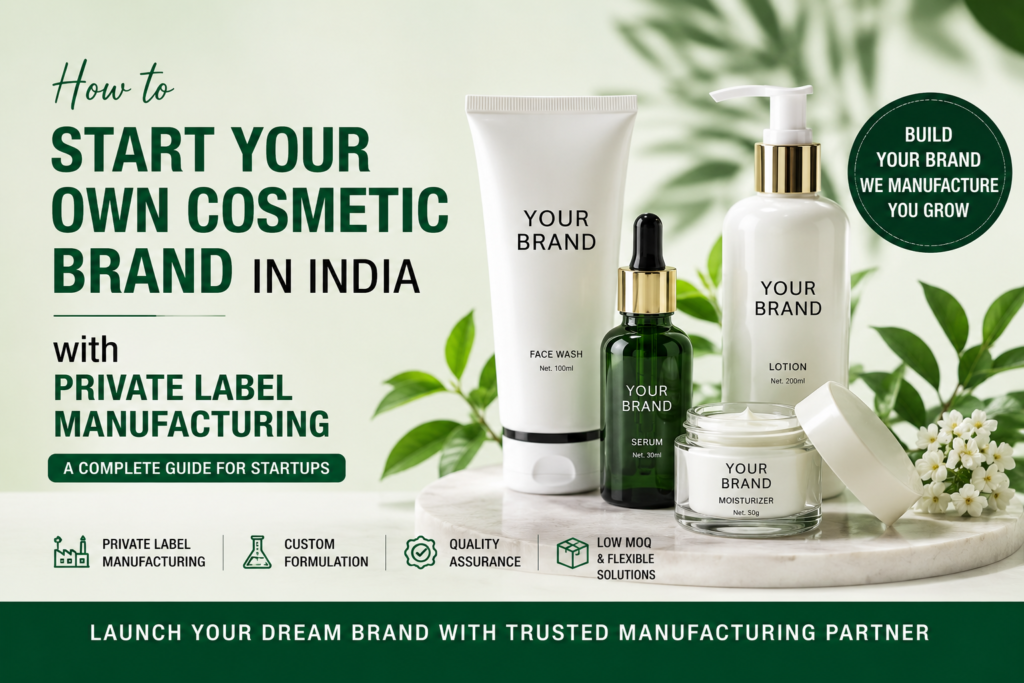
How to Start Your Own Cosmetic Brand in India with Private Label Manufacturing
Working with a private label cosmetic manufacturer is the fastest, most capital-efficient route to launching your own brand in India today. You don’t need a factory. You don’t need a PhD in formulation chemistry. What you need is a clear product idea, a target customer, and the right manufacturing partner who can take it from concept to a finished, shelf-ready product — legally compliant, properly labelled, and ready to sell.
India’s cosmetic market is projected to cross ₹2 lakh crore by 2027. D2C skincare brands, Amazon sellers, salon chains, and pharma companies are all jumping in. Most of them don’t manufacture in-house. They work with contract and private label manufacturers — and that’s exactly the model this guide breaks down.
What Private Label Cosmetic Manufacturing Actually Means
A lot of people confuse private label with third-party manufacturing. They’re related, but not the same.
In private label cosmetic manufacturing, the manufacturer has pre-developed formulations ready to go. You choose from their existing product range — a vitamin C serum, a keratin shampoo, a sunscreen SPF 50 — and they produce it under your brand name, your packaging, your label. Speed to market is significantly faster because the formulation work is already done.
Third-party manufacturing is similar but often involves custom formulation from scratch. You brief the R&D team, they develop a formula specific to your brand, and production begins after approval. This takes longer but gives you a proprietary product.
Most new brands start with private label to test the market quickly and move into custom formulation once they have traction. It’s a sensible sequence.
Why India Is the Right Place to Do This
India has one of the most mature contract cosmetic manufacturing ecosystems in Asia. Clusters in Sonipat (Haryana), Haridwar (Uttarakhand), Baddi (Himachal Pradesh), and parts of Maharashtra have manufacturers capable of producing everything from basic moisturisers to sophisticated actives-based serums at competitive per-unit costs.
Regulatory clarity has also improved. The Central Drugs Standard Control Organisation (CDSCO) governs cosmetic manufacturing under the Cosmetics Rules 2020 (amended from the Drugs and Cosmetics Act). GMP compliance is now a baseline expectation, not a premium differentiator. When you work with a WHO-GMP and ISO-certified private label cosmetic manufacturer, your products are manufactured under documented quality systems — which matters enormously when you’re selling on Amazon, supplying to pharmacy chains, or exporting.
How to Start Your Own Cosmetic Brand: The Actual Steps
Step 1 — Define Your Product Range Before Anything Else
Don’t start with “I want to launch a skincare brand.” Start with something specific: “I want to launch a 3-SKU face care range targeting working women aged 25–38, positioned at ₹399–₹799 MRP, available on Nykaa and Amazon.”
The more specific your brief, the better your manufacturer can serve you. A defined product range tells them your category (face care), your price sensitivity (which influences formulation cost), and your channel (which influences packaging requirements). Vague briefs produce vague results.
Step 2 — Understand the Minimum Order Quantities
MOQ is the first real filter in this business. Most large manufacturers won’t look at you below 2,000–5,000 units per SKU. That’s a meaningful capital commitment for a first-time brand owner.
This is where working with a manufacturer that offers low MOQ becomes commercially significant. Low MOQ doesn’t mean low quality — it means the manufacturer has structured their production batches to accommodate smaller brands. For a startup, the ability to order 500–1,000 units per SKU to test market response before scaling is the difference between a calculated launch and an expensive mistake.
Step 3 — Verify Certifications Before Signing Anything
GMP certification is non-negotiable. ISO certification adds another layer of documented quality management. Some manufacturers also carry COSMOS or organic certifications relevant to the natural/Ayurvedic segment.
Ask for the actual certificates, check the issuing body, and verify they are current. FSSAI and CDSCO guidelines are publicly available and specify exactly what a compliant cosmetic manufacturing facility should look like. Don’t skip this step. Your brand’s reputation is tied to your manufacturer’s compliance record.
Step 4 — Private Label Cosmetic Manufacturer Selection: What to Actually Evaluate
Most brand owners make the mistake of selecting a manufacturer purely on price per unit. That metric alone will mislead you. Here’s what actually matters:
Product range depth. Can they manufacture face wash, serums, sunscreens, body lotions, and haircare products under one roof? Multi-category capability reduces your vendor count and simplifies coordination.
Packaging support. Do they have in-house or tied-up packaging vendors? A private label cosmetic manufacturer that handles both formulation and packaging will shorten your lead times considerably.
Regulatory documentation. Will they provide the Certificate of Analysis (CoA), MSDS, and ingredient declarations needed for marketplace listings and export compliance? Some manufacturers hand off the product and nothing else. That’s not good enough.
Communication quality. This sounds soft, but it matters practically. A manufacturer that responds within 24 hours, provides sampling timelines in writing, and sends proactive updates on production status is far easier to build a business on than one with great infrastructure and poor follow-through.
Step 5 — Sampling, Approval, and Production
Once you’ve shortlisted your manufacturer, request physical samples across your chosen SKUs. Evaluate them on texture, fragrance, stability (leave a sample in a warm spot for a week and assess separation, colour change, consistency), and packaging fit.
After sample approval comes the production agreement — quantities, lead times, payment terms, and labelling specifications. In India, cosmetic labels must comply with the Legal Metrology (Packaged Commodities) Rules and include net quantity, ingredient list (INCI names), manufacturing and expiry dates, batch number, manufacturer name and address, and the MRP.
Don’t print labels before your manufacturer confirms the final filled weight and packaging dimensions. Small mismatches create compliance problems.
Common Mistakes First-Time Brand Owners Make
Ordering too many SKUs at launch is the most common and expensive error. Three focused SKUs executed well will always outperform ten average ones. Test, learn, then expand.
Ignoring shelf life testing is another. Cosmetics need stability data. Ask your private label cosmetic manufacturer for accelerated stability test reports on your formulations. 24 months is the standard expected shelf life for most skincare products in India.
Underinvesting in packaging is the third. The formulation might be excellent, but if the packaging looks generic, your product won’t convert — especially in e-commerce where the unboxing photograph is marketing.
The Real Cost Structure You Should Know
Ballpark unit economics for a basic skincare product manufactured in India:
A 50ml face serum at 1,000-unit MOQ typically costs between ₹80–₹150 per unit for formulation and filling, depending on actives and packaging. Labelling adds ₹10–₹25 depending on complexity. Logistics to your warehouse adds another ₹15–₹30 per unit.
So landed cost of ₹120–₹200 per unit, sold at ₹499 MRP with a 40% channel margin, still leaves a workable gross margin for a lean D2C brand. The economics improve significantly at higher volumes.
Private Label Cosmetic Manufacturer: Who This Model Works For
This model works particularly well for pharma companies adding a cosmetic/OTC personal care vertical. Their compliance mindset and existing distributor relationships make the transition natural. It works for Amazon and Meesho sellers who want branded, differentiated products instead of reselling commodities. It works for salon chains wanting to retail their own products to existing clients. And it works for D2C founders who understand their target customer and want to move fast without building manufacturing infrastructure.
If any of these describe you, you’re already most of the way there. What you need next is the right manufacturing partner.
Querit Healthcare is a GMP and ISO certified private label cosmetic manufacturer in India, based in Sonipat, Haryana. Contact us to discuss your product requirements, MOQ, and timelines. Also explore our full range of cosmetic manufacturing services — from skincare and haircare to Ayurvedic and bath & body products.